

There are many hurdles to be overcome.
But sometimes the scariest of challenges can bring the brightest of surprises.
Enjoy the moment.

There are many hurdles to be overcome.
But sometimes the scariest of challenges can bring the brightest of surprises.
Enjoy the moment.

Don’t rise to arguments.
Respect others beliefs, even if they go against your own.
When a battle ensues, take a step back, remain objective and find peace.
Your inner calm will see you through.

In a world where we are badgered to wash our hands for twenty seconds, now is the time to care and protect.
Mask yourself and protect others.
Nature will win out either way, so what is the harm?

Relish in the fruits of your labour.
You have earned this reward, so sit back, relax, and take pleasure in what has been achieved.
You deserve this.

Things sometimes seem vast and impossible to overcome.
Break your challenge down into manageable chunks.
Tick off one part at a time and your journey will seem less daunting.

Frederick Brooks was born in the spring of 1897, the ninth of eleven children to Stephen and Grace Brooks. Stephen worked as a woodsman in Bredhurst, Kent, a trade his eldest sons followed him into.
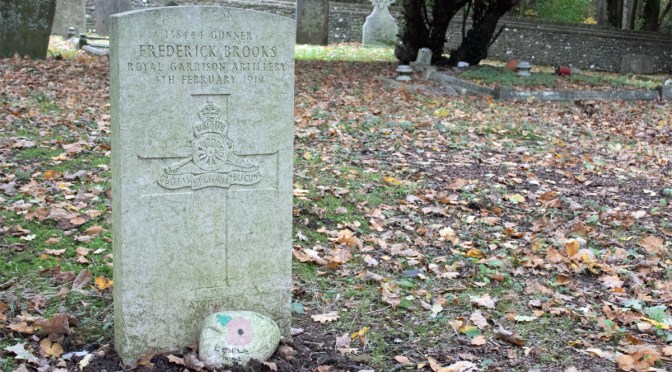
Frederick’s service records show that, when he enlisted in nearby Rainham, he was working as a fence maker. He was 5ft 6ins (168cm) tall, weighed 143lbs (65kg) and had fair physical development. He joined up in September 1915 and was assigned to the 2/1 Company Kent Royal Garrison Artillery.
Gunner Brooks’ early service was on home soil as part of the Territorial Force. However, he was transferred overseas as part of the British Expeditionary Force on 10th March 1917, where he served for nearly two years.
Frederick fell ill in January 1919, and was brought back to the UK for treatment. He was admitted to the Weir Red Cross Hospital in Balham, London, with bronchial pneumonia. He succumbed to heart failure just a few days later, on 4th February 1919. He was just 21 years old.
Gunner Frederick Brooks lies at rest in a peaceful corner of the secluded graveyard of St Peter’s Church in his home village of Bredhurst.
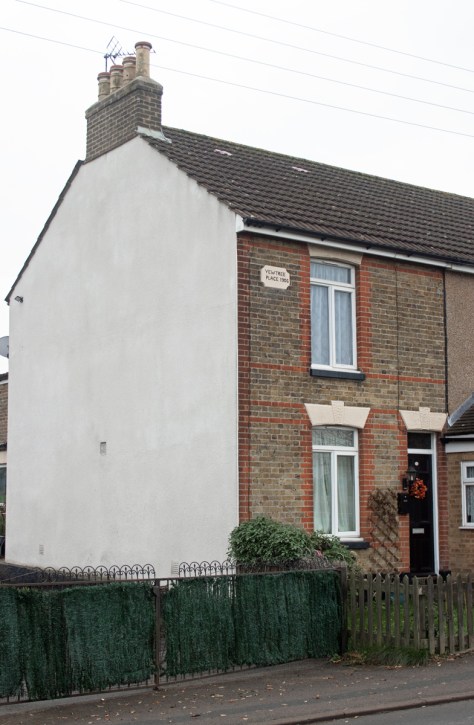
Frederick’s life throws a couple of coincidences my way. I used to live within spitting distance of his village, Bredhurst, and, indeed, have drive past his family home countless times. I also happened to have been born in the same hospital – the Weir in Balham – where Frederick had passed away 53 years earlier.
For the stories of more of the fallen from the Great War, take a look at my Commonwealth War Graves page.

Reuben Victor Stanley Hadlow was born in the spring of 1898. He was one of thirteen children to John Charles Tarpe Hadlow and his wife Gertrude, publicans at the Star pub in Whitstable, Kent.
When war broke out, Reuben was working as a blacksmith; he enlisted in the army in the summer of 1914, serving on the home front.
In February 1916 Private Hadlow transferred to the Royal Flying Corps as a Air Mechanic 2nd Class, and was assigned to the 65 Training Squadron in Croydon. He was promoted to Air Mechanic 1st Class six months later.
When the RFC became the Royal Air Force, Air Mechanic Hadlow moved across to the new institution. He moved to support 156 Squadron in November 1918, then the 35 Training Depot Station shortly after.
Air Mechanic Hadlow contracted phthisis (tuberculosis) towards the end of that year, which led to his being discharged from the RAF on 22nd January 1919.
Reuben’s health did not recover after returning home – his parents were running the King’s Arms pub in Boxley near Maidstone by this point. He passed away on 17th September 1919, aged twenty-one.
He lies at rest in the churchyard of St Mary and All Saints, in his parent’s village.
Poignantly, his gravestone is not a traditional war grave. Instead it states that he died “after a painful illness and serving his country 4 1/2 years”.
For the stories of more of the fallen from the Great War, take a look at my Commonwealth War Graves page.

The world may appear in a state of confusion, but don’t let it take you with it.
Pause. Take a step back. Breathe.
Clarity will return and sense and purpose win out.

Sometimes you have to take a step back to fully appreciate the view.
The devil is in the detail, but the details often don’t enable you to be objective about the situation.
Pause. Review. Take a new perspective.

Stand apart.
Shine in a way nobody else can.
It may feel like you’re on your own, but look behind you and you’ll see that you’re leading the pack.
Commemorating the fallen of the First World War who are buried in the United Kingdom.
Looking at - and seeing - the world
Nature + Health
ART - Aesthete and other fallacies
A space to share what we learn and explore in the glorious world of providing your own produce
A journey in photography.
turning pictures into words
Finding myself through living my life for the first time or just my boring, absurd thoughts
Over fotografie en leven.
Impressions of my world....






 CKPonderingsToo