As mentioned in the previous post, it is often a challenge to find details of the fallen soldiers whose graves pepper the churchyards of the UK.
Sadly, Gunner Thomas Kelly is one of those names lost to time.
Born in 1893, he lived in Alsager, Cheshire and enlisted in the Royal Field Artillery. Wounded, he was moved to the Yeatman Hospital in Sherborne, Dorset, but died of his wounds on 11th January 1918.
He was buried in the town’s cemetery on 16th January 1918; he was just 25.
For the stories of more of the fallen from the Great War, take a look at my Commonwealth War Graves page.
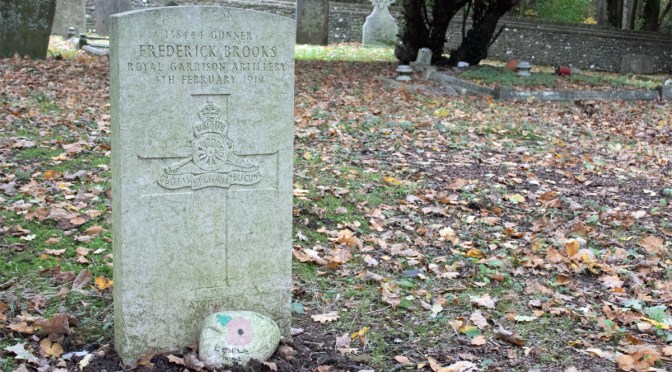
Frederick Brooks was born in the spring of 1897, the ninth of eleven children to Stephen and Grace Brooks. Stephen worked as a woodsman in Bredhurst, Kent, a trade his eldest sons followed him into.
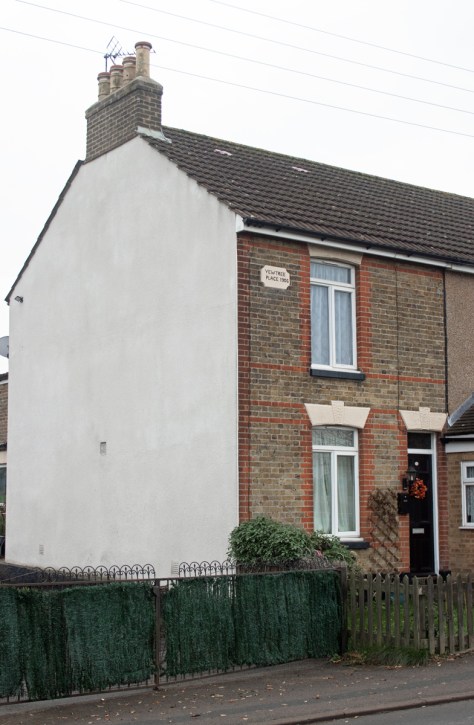
Yewtree Cottages in Bredhurst, home to the Brooks Family
Frederick’s service records show that, when he enlisted in nearby Rainham, he was working as a fence maker. He was 5ft 6ins (168cm) tall, weighed 143lbs (65kg) and had fair physical development. He joined up in September 1915 and was assigned to the 2/1 Company Kent Royal Garrison Artillery.
Gunner Brooks’ early service was on home soil as part of the Territorial Force. However, he was transferred overseas as part of the British Expeditionary Force on 10th March 1917, where he served for nearly two years.
Frederick fell ill in January 1919, and was brought back to the UK for treatment. He was admitted to the Weir Red Cross Hospital in Balham, London, with bronchial pneumonia. He succumbed to heart failure just a few days later, on 4th February 1919. He was just 21 years old.
Gunner Frederick Brooks lies at rest in a peaceful corner of the secluded graveyard of St Peter’s Church in his home village of Bredhurst.
Frederick’s life throws a couple of coincidences my way. I used to live within spitting distance of his village, Bredhurst, and, indeed, have drive past his family home countless times. I also happened to have been born in the same hospital – the Weir in Balham – where Frederick had passed away 53 years earlier.
For the stories of more of the fallen from the Great War, take a look at my Commonwealth War Graves page.
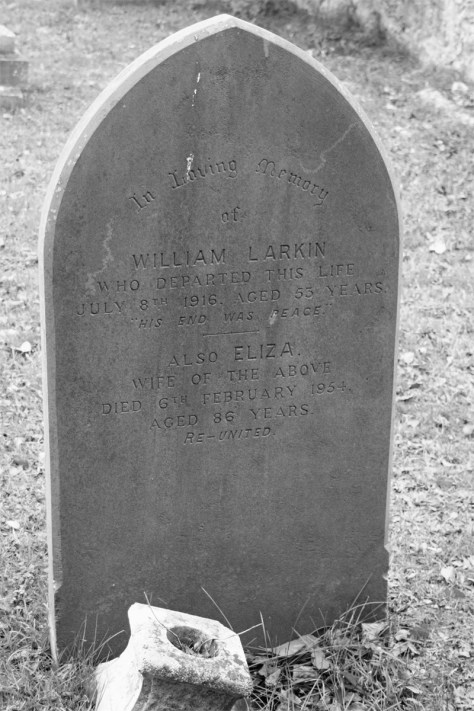
William Larkin was born in 1863, the eldest son of Alfred and Frances Larkin from Cranbrook in Kent.
He disappears off the radar for a few censuses – there are too many variations on his surname to identify exactly where he was on the 1881 and 1891 documents.
From later documents, however, we can identify that he married Eliza in around 1886; the couple had no children. By the 1901 censes the couple were living to the north of Maidstone; ten years later, they were running the Fox & Goose pub in Weavering, Kent.
Private Larkin’s military service is also lacking in documentation, but some information can be pieced together.
Originally enlisting in the Royal West Kent Regiment, he (was) transferred over to the Royal Defence Corps, and served on home soil.
On Sunday 2nd April 1916, Lance Corporal Larkin was on guard at a gunpowder factory in Faversham, Kent. As the Ministry of Munitions reported at the time:
During the weekend a serious fire broke out in a powder factory in Kent, which led to a series of explosions in the works.
The fire, which was purely accidental, was discovered at midday and the last of the explosions took place shortly after two in the afternoon.
The approximate number of casualties is 200.
Thanet Advertiser: Saturday 8th April 1916.
William was not killed during the incident, but Boxley Parish Council (who covered the Weavering area) carried out research on the names on the village war memorial. According to that research, William “developed cancer after the ‘Faversham Powder Works’ explosion”. He died two months later, on 8th July 1916. He was 53 years of age.
Lance Corporal William Larkin lies at rest in the graveyard of St Mary & All Saints Church in Boxley, Kent.
The 1916 explosion at Faversham was the worst in the history of the British explosives industry.
At 14:20 on Sunday 2 April 1916, a huge explosion ripped through the gunpowder mill at Uplees, near Faversham, when a store of 200 tons of trinitrotoluene (TNT) was detonated following some empty sacks catching fire. The TNT and ammonium nitrate (used to manufacture amatol) had exploded.
The weather might have contributed to the start of the fire. The previous month had been wet but had ended with a short dry spell so that by that weekend the weather was “glorious”, providing perfect conditions for heat-generated combustion.
Although not the first such disaster at Faversham’s historic munitions works, the April 1916 blast is recorded as “the worst ever in the history of the UK explosives industry”, and yet the full picture is still somewhat confused.
The reason for the fire is uncertain. And considering the quantity of explosive chemicals stored at the works – with one report indicating that a further 3,000 tons remained in nearby sheds unaffected – it is remarkable, and a tribute to those who struggled against the fire, that so much of the nation’s munitions were prevented from contributing further to the catastrophe.
(Information about the explosion drawn from Wikipedia.)
For the stories of more of the fallen from the Great War, take a look at my Commonwealth War Graves page.
Reuben Victor Stanley Hadlow was born in the spring of 1898. He was one of thirteen children to John Charles Tarpe Hadlow and his wife Gertrude, publicans at the Star pub in Whitstable, Kent.
When war broke out, Reuben was working as a blacksmith; he enlisted in the army in the summer of 1914, serving on the home front.
In February 1916 Private Hadlow transferred to the Royal Flying Corps as a Air Mechanic 2nd Class, and was assigned to the 65 Training Squadron in Croydon. He was promoted to Air Mechanic 1st Class six months later.
When the RFC became the Royal Air Force, Air Mechanic Hadlow moved across to the new institution. He moved to support 156 Squadron in November 1918, then the 35 Training Depot Station shortly after.
Air Mechanic Hadlow contracted phthisis (tuberculosis) towards the end of that year, which led to his being discharged from the RAF on 22nd January 1919.
Reuben’s health did not recover after returning home – his parents were running the King’s Arms pub in Boxley near Maidstone by this point. He passed away on 17th September 1919, aged twenty-one.
He lies at rest in the churchyard of St Mary and All Saints, in his parent’s village.
Poignantly, his gravestone is not a traditional war grave. Instead it states that he died “after a painful illness and serving his country 4 1/2 years”.
For the stories of more of the fallen from the Great War, take a look at my Commonwealth War Graves page.
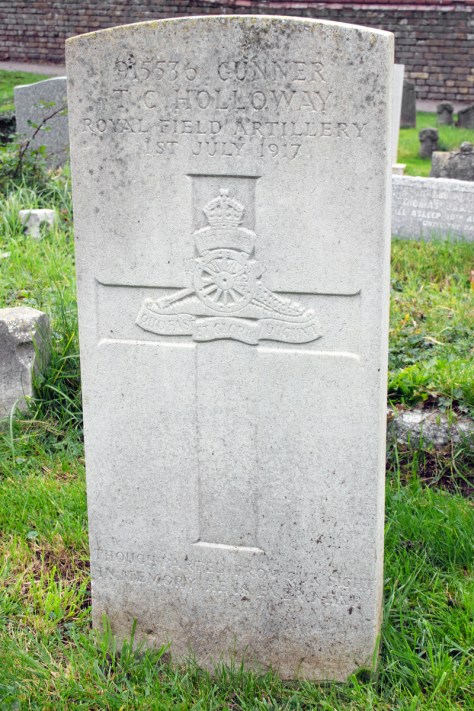
Thomas Charles Holloway was born in Chatham, Kent in 1893. The fourth of five children, his parents were Joseph, a domestic coachman, and Caroline Holloway.
By the time of the 1911 census, Thomas had left school and was working in a corn warehouse.
Thomas presented a bit of a challenge when I was researching his history.
His military records show that he enlisted on 31st December 1914, signing up to the Royal Field Artillery. However, Gunner Holloway’s service records show that he was posted on 9th January 1915, before being discharged as medically unfit just a week later. The records confirm that he served for 16 days.
The medical attestation states that he was discharged because of cardiac dilation and hypertrophy, a systolic murmur and dyspnoea, all heart-related conditions.
Despite only serving for just over a fortnight, he was afforded a Commonwealth War Grave when he died.
Searching the local newspapers of the time, a bigger story was unveiled.
The death of Bombardier Thomas Holloway, aged 24, of the RFA… occurred in a hospital at Cambridge. He was kicked by a horse in the course of his training, nearly two years ago, and had practically been on the sick list ever since. On recovering from the effects of the accident, he was seized with spotted fever at Seal, and ultimately succumbed to paralysis of the brain.
East Kent Gazette: Saturday 21st July 1917
The discrepancies between the original discharge and the newspaper report are intriguing. Either way, this was a young life cut far too short: he was 24 years old.
Gunner Thomas Holloway lies at rest in St Margaret’s Churchyard, in his home town of Rainham in Kent.
For the stories of more of the fallen from the Great War, take a look at my Commonwealth War Graves page.







 CKPonderingsToo