Tag Archives: history

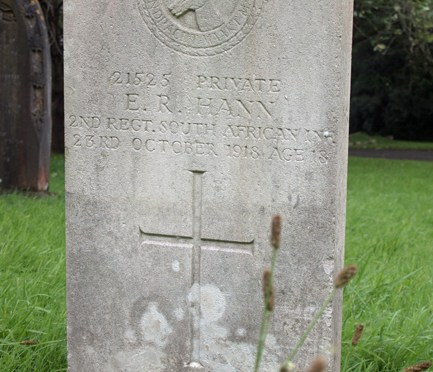
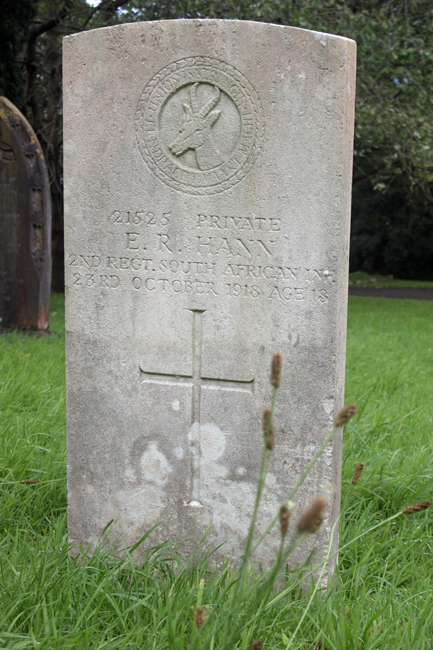
CWG: Private Edwin Hann

Edwin Robert Hann was born in Johannesburg, South Africa, to Albert Edward and Jemima Jane Hann in around 1900.

Research has led me to numerous dead ends regarding Edwin’s life. Hann’s tombstone shows that he enlisted in the 2nd Regiment of the South African Infantry.

The 2nd Regiment served in numerous key battled on the Western Front, including Ypres, Passchendale, Marrieres Wood and Messines. Their last major engagement was at Le Cateau in early October 1918. Given how soon afterwards Private Hann passed away, it seems possible that he was fatally wounded – or at least suffered trauma – during this battle.

His war pension records suggest that he died at a military hospital in Woking, Surrey. A little research suggests that, unless this was the medical wing of the local army barracks, then it is likely that Hann was treated at the former Brookwood Hospital (at the time known as Brookwood Asylum or the Surrey County Lunatic Asylum).

While I can find nothing concrete to confirm this, other Brookwood records suggest that fellow patients were either suffering the effects of shell shock or mustard gas. It is reasonable to assume, therefore, that Private Hann passed away as an indirect result of the fighting on the front, rather than a direct one.

A second mystery arises around his burial, however.

Born in South Africa, fighting on the Western Front, treated and passing in Surrey. How did Edwin Hann come to be buried in a cemetery in Glastonbury?

Again, I can only surmise why this poor teenager was buried so far from home. Hann is a fairly common name in Somerset and, from a bit of research on Ancestry.co.uk, at the turn of the last century there are a large number of Hanns in and around Glastonbury and Shepton Mallet, and in particular a lot of Alberts and Edwards (like Private Hann’s father). The assumption can only be, therefore, that Edwin came to be buried close to a where his father’s family lived.

https://www.findagrave.com/memorial/146326981/edwin-robert-hann
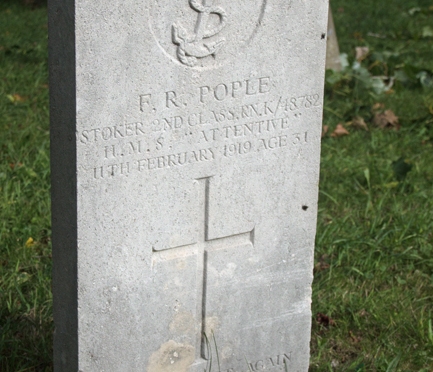

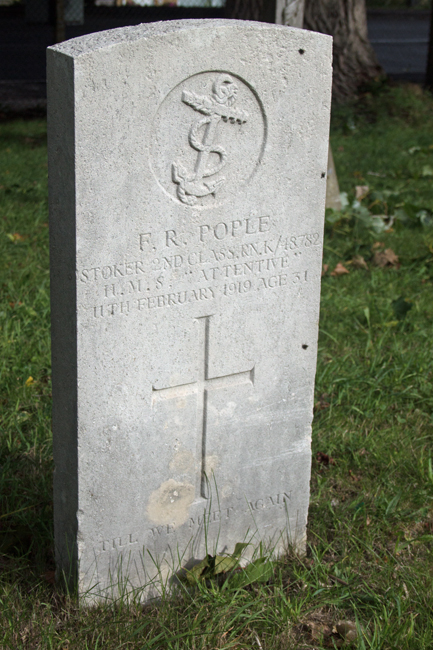
CWG: Stoker Frederick Pople

Frederick Richard Pople was the second son of Frederick and Emma Pople, born in 1887 in Street, Somerset. He married Beatrice Cox in 1910 and, by the following year the newlyweds had moved to South Wales, when Frederick wound work on the railways.

Frederick joined relatively late into the war – he was 30 when he enlisted on 25th January 1918. He training took place at HMS Vivid II in Devonport and, by March of that year, he was serving as a stoker on the HMS Attentive III, part of the Dover patrol.

Sady, Stoker Pople’s service was short-lived. While he continued to work on the HMS Attentive after the conclusion of hostilities in November 1918, passed away from pneumonia on 11th February 1919. He is buried in Glastonbury Cemetery.

https://www.findagrave.com/memorial/146327274/frederick-richard-pople


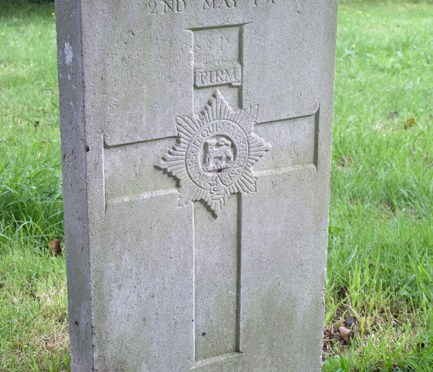
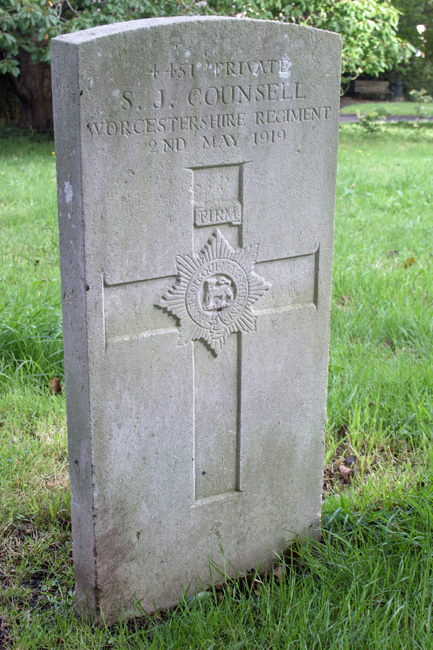
CWG: Private Stanley Counsell

Stanley John Counsell was born in September 1896 to George and Ellen, farmers in Glastonbury.

The youngest of five children, Stanley was an apprentice carpenter by the time he enlisted with his brothers Lawrence and Wilfred.

Private Counsell joined the Worcestershire Regiment in 1915 and was sent into action in France in September 1916.

He suffered medically during the war, succumbing to tonsillitis and diarrhoea during his time in France. A bout of tuberculosis in late 1918 saw Stanley shipped back to the UK and admitted to a hospital in Newcastle-upon Tyne.

The end of the Great War came and went, and Stanley was finally discharged from the army in March 1919, as he was no longer medically fit for war service.

On 2nd May 1919, less than six weeks after being discharged, Private Stanley Counsell passed away. He was a victim not of the war, but of the subsequent influenza pandemic, which killed 250,000 people in the UK alone.

https://www.findagrave.com/memorial/146326854/stanley-john-counsell


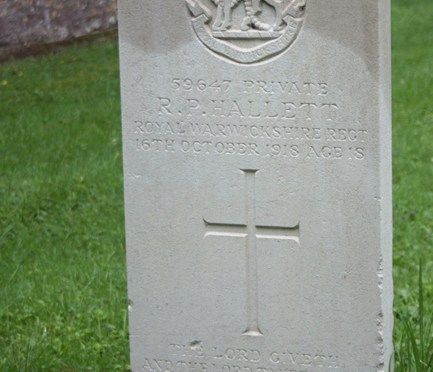
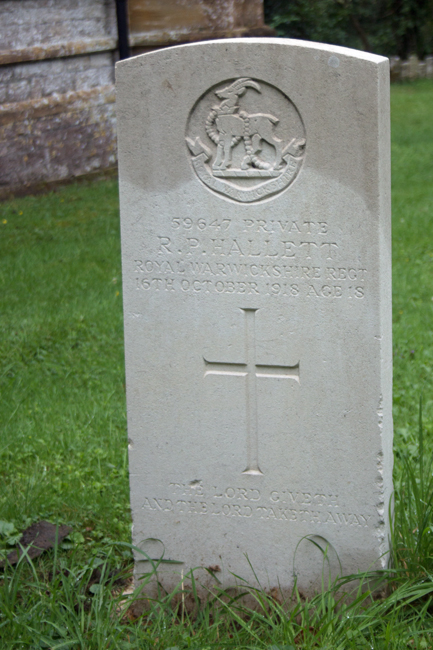
CWG: Private Roberts Hallett

Private Roberts Pretoria Hallett was born in the summer of 1900, to Frank – a shepherd from Charlton Adam – and Emily, who came from Charlton Mackrell. Roberts (the correct spelling) was the youngest of eleven children.

Roberts was just twelve when his father died, and, when war came, he enlisted in Taunton, along with his brothers, Francis and William. The Great War was not kind to Emily Hallett: her son William died while fighting in India in 1916; Francis died in the Third Battle of Ypres in June 1917.

Roberts was assigned to the 5th Battalion Royal Warwickshire Regiment; while I’ve been unable to identify exactly when he saw battle, by the last year of the war he would have been involved in the fighting in northern Italy.

What we can say for certainty was that is was shipped home at some point towards the end of the war, and died – presumably of his injuries – in Newcastle-upon-Tyne on 16th October 1918.

William Hallett was buried in India, Francis in Belgium. Private Roberts Hallett, therefore, is the only one of the three brothers to be buried in the churchyard of St Mary’s in his birthplace of Charlton Mackrell.

https://www.findagrave.com/memorial/203685613


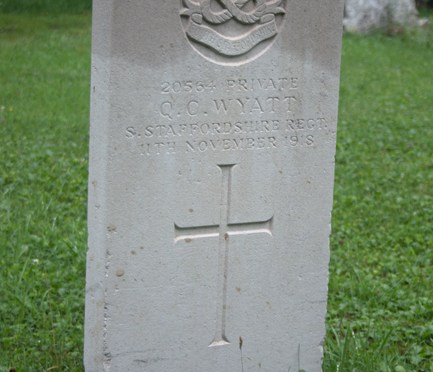
CWG: Private Quinton Wyatt

Private Quinton Charles Wyatt was born in the Gloucestershire town of Northleach in 1893 to William and Elizabeth. His mother died when he was a toddler and, by the time war was declared, Quinton was working as a farm labourer and waggoner.

He joined the 8th Battalion of the South Staffordshire Regiment on 22nd November 1915. He was posted to France four months later, but medically discharged from the Army on Boxing Day 1917.

Private Wyatt died in Charlton Mackrell on 11th November 1918 – Armistice Day – and buried in St Mary’s churchyard.

https://www.findagrave.com/memorial/203685657


Celebration

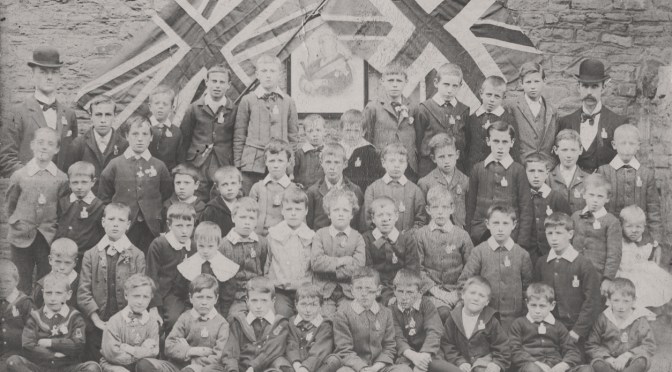
Another photo from my ‘junk shop’ archive, and it’s nice to have one that’s fairly easy to narrow down in date and this is very much a celebratory ‘posed’ shot.

On the wall in the background, in between the two Union Flags is a portrait of Queen Victoria.

The forty-odd children in the picture and the two adults (their teachers?) are all smartly dressed and they are wearing a cross-shaped medal. These were given out on one of two occasions – the Queen’s Golden Jubilee and her Diamond Jubilee.

This narrows the date down to either June 1887 or 1897. Sadly there is nothing on the Carte de Visite to confirm for certain which of the two occasions the photograph celebrates, but either way, it’s a nice insight into commemorations 120+ years ago!


This month’s Mass Observation post was well received, and in these weird and wonderful times, we all need a bit of colour!

Moving forward, the project for June has a new theme…

RANDOM

Who doesn’t like a bit of randomness? Interpret the theme as you will!

To take part, simply take a photo around the theme of random:

  • Email the image to adayinphotographs@outlook.com by Sunday 31st May 2020.
  • Images should be a maximum of 650 pixels wide.
  • Include your name, website/blog address and a short note about the image, including where it was taken.
  • Come back and see the results on Sunday 7th June!

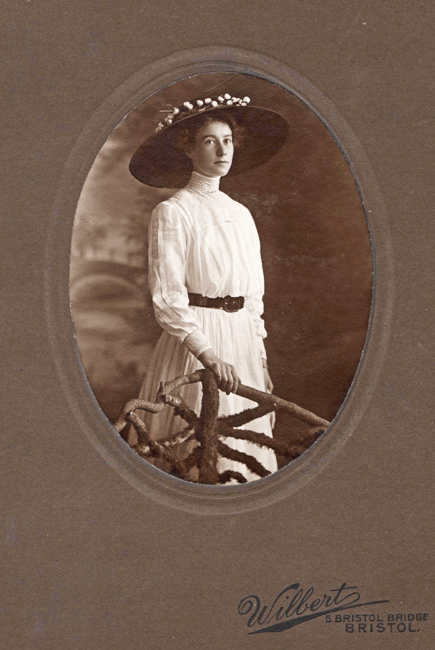
Miss Adelaide Mabel Dickinson

Miss Dickinson still had butterflies. But that, as her friends reminded her, was only to be expected. Her marriage celebrations were only a matter of days away and getting closer by the hour.

William – that is to say Mr William Walter – was a kind man, and the perfect match. No matter how often her mother told her that, Adelaide still didn’t entirely believe it.

She knew love to be important, and she knew she would come to love Mr Walter. But for now the butterflies in her stomach were not to be calmed.

Adelaide’s main worry was what happened after she and William exchanged their vows. He was older then her – nearly twelve years older – and she knew he had more experience than she could imagine. His three children were testament to that.

That was another thing. She wasn’t ready for motherhood! While Mr Walter employed two nannies, what were the expectations on her? To raise the three girls as her own. She couldn’t replace their mother – poor Evangeline Walter, whose demise had come far too soon. Would they like her? Would they warm to her?

The butterflies fluttered more quickly, as if buffeted by a sudden breeze. She grasped the chair more firmly and breathed in deeply.

It would be alright. William had reassured her of that. But there had been something about that reassurance, something hollow about it, that had left her less reassured than she had wanted.

“Pull yourself together, Adelaide,” she muttered, straightening up and stifling the gasp she could sense was coming.

She heard a clicking from behind the light.

“There you go, Miss. All done.”


(This is a story based on an anonymous Carte de Visite found in a junk shop, and should not be seen as a true reflection of this person’s life or that of the photographer, Wilbert of Bristol Bridge, Bristol.)


This month’s Mass Observation post was well received, and in these weird and wonderful times, we all need a bit of colour!

Moving forward, the project for June has a new theme…

RANDOM

Who doesn’t like a bit of randomness? Interpret the theme as you will!

To take part, simply take a photo around the theme of random:

  • Email the image to adayinphotographs@outlook.com by Sunday 31st May 2020.
  • Images should be a maximum of 650 pixels wide.
  • Include your name, website/blog address and a short note about the image, including where it was taken.
  • Come back and see the results on Sunday 7th June!

Mrs Esther Alice Wilberforce

She had waited for what seemed like hours now, in the damn uncomfortable chair, that creaked every time she moved slightly and was as hard as the front step she had cleaned that very morning. But she kept her lips tightly shut, knowing that her son and daughter had paid a lot for her to have this photograph taken.

She didn’t believe in this kind of frippery, of course – it was a waste of money that could be better spent on the house – but she knew Joseph and Maria had meant well.

The Bristol studio Esther Wilberforce had found herself in was draughty, and the cold, damp air was threatening to make her cough.

The photographer – a Mr Houlson – had said she looked the perfect Victorian woman, which was a little embarrassing. He was smartly dressed and young enough to be her grandson. But he wore a fixed smile of someone desperate and she wondered if his business was not all he had expected it to be. She sensed the disapproval of Mr Houlson’s father – his was the money at risk, of course – and felt this young man was trying to come across as eager and professional as possible to hide the resignation of a failing business.

Still, she would have to recommend him to Mrs Whitmore, of course. If nothing else, the Reading Group would get to hear about the photograph – what was it Mr Houlson called it? A Visiting Card? – so she had to remain upbeat.

“Just another 30 seconds, Mrs Wilberforce,” the young man said from the darkness beyond the camera.

Just a few more seconds, and she could rest her aching bones and let out that cough!


(This is a story based on an anonymous Carte de Visite found in a junk shop, and should not be seen as a true reflection of this person’s life or that of the photographer, R Houlson of Griffin Hill, Bristol.)


This month’s Mass Observation post was well received, and in these weird and wonderful times, we all need a bit of colour!

Moving forward, the project for June has a new theme…

RANDOM

Who doesn’t like a bit of randomness? Interpret the theme as you will!

To take part, simply take a photo around the theme of random:

  • Email the image to adayinphotographs@outlook.com by Sunday 31st May 2020.
  • Images should be a maximum of 650 pixels wide.
  • Include your name, website/blog address and a short note about the image, including where it was taken.
  • Come back and see the results on Sunday 7th June!