Tag Archives: war

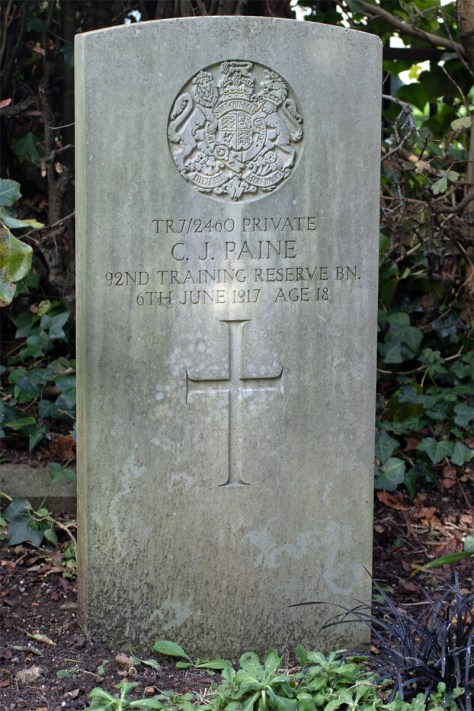
CWG: Private Cecil Paine

Private Cecil John Paine

Cecil John Paine was born in Sherborne, Dorset, in May 1899, the son of John and Emily Paine. He was the fifth of seven children, and the second son.

Cecil’s military records are sparse, but the local newspaper provides more information. According to the Western Gazette, Cecil joined up on reaching his 18th year, and had only been in service for three weeks, when he succumbed to pneumonia at Chiseldon Camp in Wiltshire.

Private Cecil Paine lies at rest in Sherborne Cemetery.


As an aside, Chiseldon Camp was initially set up to train new soldiers. In 1915, part of it was developed into a hospital for wounded soldiers before, in 1916, it began to treat soldiers coming back from the front who had contracted VD. Interesting times that Private Paine probably knew little about.


Cecil’s eldest brother, Frederick William Paine also served in the Great War. He had enlisted in the navy in 1903, initially for 12 years, but continued on and was finally discharged in 1919.


For the stories of more of the fallen from the Great War, take a look at my Commonwealth War Graves page.

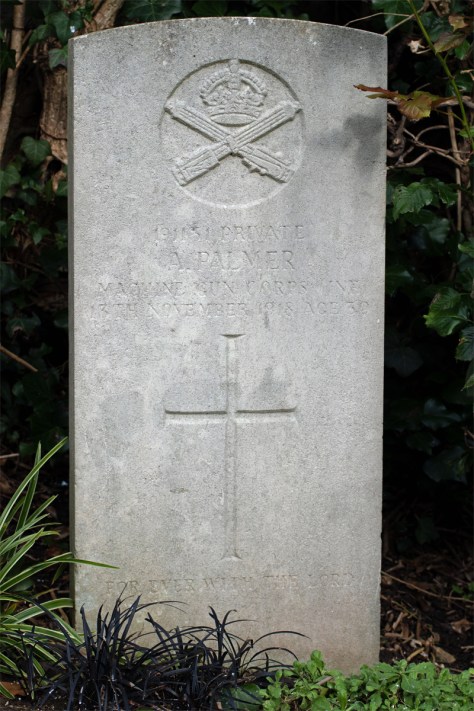
CWG: Private Arthur Palmer

Private Arthur Palmer

Arthur Palmer was born in Bicester in 1889 to groomsman George Palmer and his wife Annie. Arthur was the eldest of five children, five boys and one girl.

By 1911, the family had moved to Dorset, where George continued to work as a groom. His son, Arthur, had also gone into domestic service, and was a footman. Presumably this was under the same employ as his father, although the records do not confirm this.

This is where the trail for Arthur Palmer dries up.

From his gravestone, we know he served in the Machine Gun Corps (MGC). The Register of Soldiers’ Effects confirms he was in the 3rd Company; this was formed in January 1916, so Private Palmer can only have enlisted after that date.

Online research only brings up MGC military service records for an Arthur George Palmer, who lived in Kettering. However, this Private survived the war, so could not be the one buried in Dorset. There is nothing in contemporary newspapers to suggest that there was anything untoward or unusual about his passing.

All I can say for certain is that Private Arthur Palmer died at the Cannock Chase Military Hospital on 13th November 1918.

He lies at rest in Sherborne Cemetery, Dorset. He was 30 years old.


For the stories of more of the fallen from the Great War, take a look at my Commonwealth War Graves page.


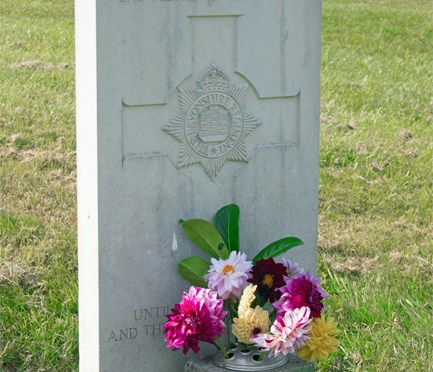
CWG: Private Charles Stodgell

Private Charles William Stodgell

Charles William Stodgell was born in 1878, the eldest son of Samuel and Mary Stodgell. His father was an agricultural labourer, while his mother was a glover. Charles followed into farm work, becoming a carter by time of the 1901 census.

Charles married Mabel Duke in 1898 and the young couple had two daughters – Ida and Florence – in the following few years.

When war came, Charles was called up. He enlisted in June 1916, joining the Devonshire Regiment before being transferred to the Agricultural Company. His record shows that he stood at 5ft 6ins (1.67m) and weighed 10st 2lbs (64kg) and his build, health and experience is probably why he ended up in service where he did.

Private Stodgell was demobbed at the end of the war, and returned home on furlough (a word not just linked to everything 2020 has thrown at us!). Sadly, before he was fully demobbed, he contracted influenza, and died on 2nd February 1919.

Charles William Stodgell lies at rest in his home village of North Curry, in the churchyard of St Peter & St Paul.


For the stories of more of the fallen from the Great War, take a look at my Commonwealth War Graves page.

CWG: Gunner Samuel Hayes

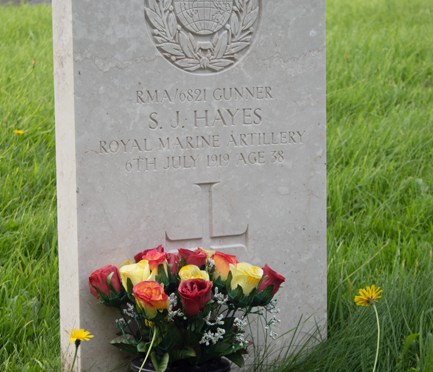
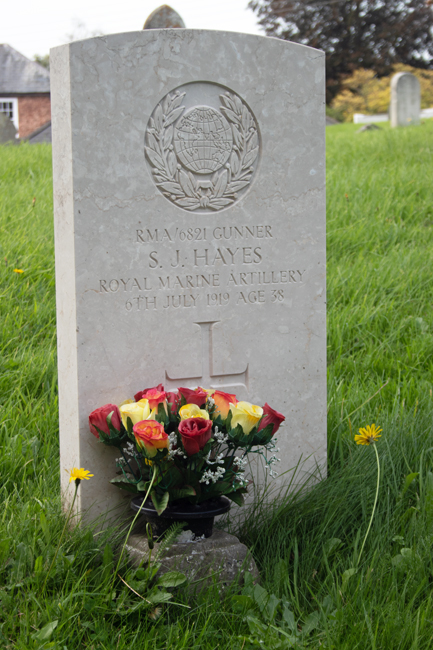
Gunner Samuel James Hayes

Samuel James Hayes was born in the Somerset village of Milverton in May 1879. He was the eldest son of James and Harriet.

James was an agricultural labourer, but Samuel wanted more than this; he enlisted in the Royal Marine Artillery in February 1897, three months before his 18th birthday.

The 1901 census finds Gunner Hayes in the Eastney Barracks in Portsmouth, while ten years later, he was on board the HMS Swiftsure in the Mediterranean.

In May 1912, he married Annie Thorne, also from Milverton, in his home village. Two years later, just before Christmas 1914, their first – and only – child, Lionel, was born.

I have struggles to find anything specific relating to Gunner Hayes’ wartime service. He certainly continued to serve, and by the time of his death had clocked up more than twenty years’ in the Royal Marine Artillery.

Samuel passed away on 6th July 1919, at the age of 38. One record I have located suggests that he died in a military hospital in Malta, but whether he passed there or in the UK, he was buried back in Somerset.

Gunner Samuel James Hayes lies at rest in St Michael & All Angel’s churchyard in Milverton.


CWG: George Henry Stone

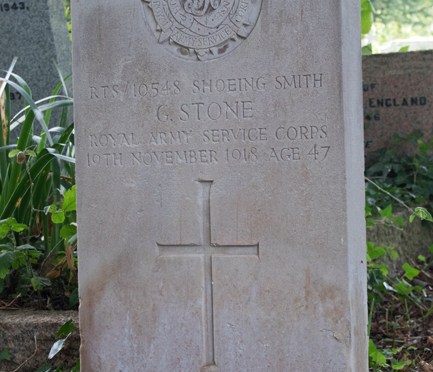
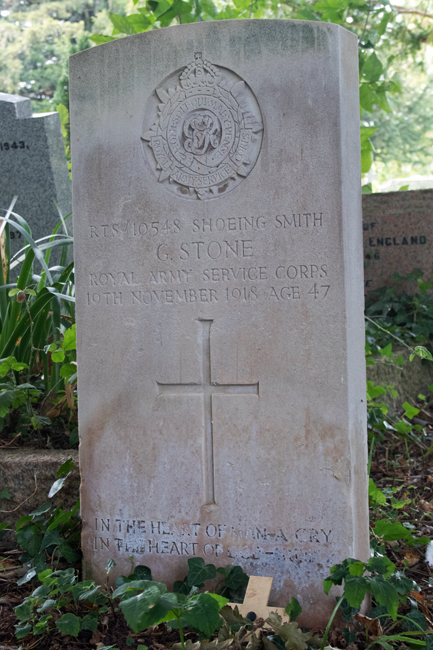
Shoeing Smith George Henry Stone

George Henry Stone was born in 1872, son of Milverton’s blacksmith James Stone and his wife Mary Ann. He followed in his father’s footsteps and, by the time he married Mary Florence Paul in 1894, he was also working in the forge in Milverton.

George and Mary had eight children – seven girls and one boy; by the time he signed up in 1915, he listed himself as a blacksmith.

His military records show that he was medically certified as Category B2 (suitable to serve in France, and able to walk 5 miles, see and hear sufficiently for ordinary purposes). He was assigned to the Remount Depot in Swaythling, Southhampton, which was built specifically to supply horses and mules for war service. (In the years it was operating, Swaythling processed some 400,000 animals, as well as channelling 25,000 servicemen to the Front.)

While serving George contracted pneumonia. He was treated in Netley Military Hospital, but passed away on 19th November 1918, aged 47.

Shoesmith George Henry Stone lies at peace in a quiet corner of St Michael & All Angel’s churchyard in his home village of Milverton.


CWG: Private George Symons

Private George Symons

George Symons was born in 1895 to Charles and Rosa Symons. He was the third of five sons.

Charles worked as a carter on a farm, and his son became a cowman as soon as he could leave school.

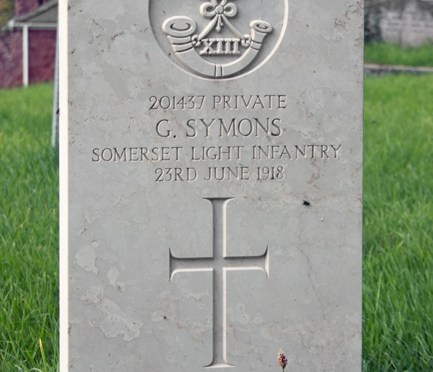
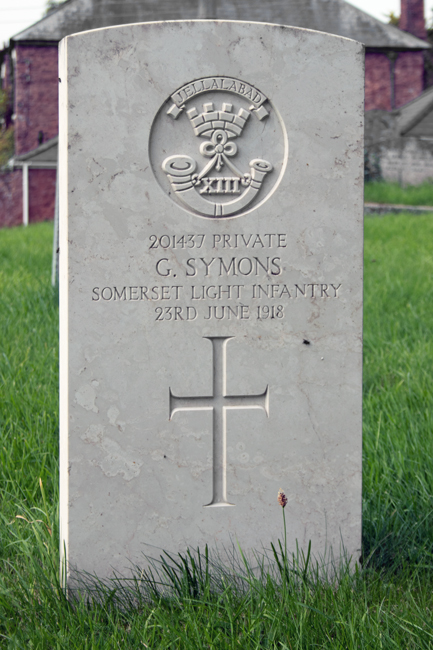
Military records for George Symons are pretty sparse. From his gravestone we know he joined the Somerset Light Infantry; the army’s register of soldier’s effects confirm that he died in a military hospital on home soil; £23 7s 11d went to his father.

It can be assumed, therefore, that Private Symons served on the Western Front (where the Somerset LI was), was injured and brought home for treatment or rehabilitation.

Private George Symons lies at rest in the churchyard of St Michael and All Angels in Milverton.


CWG: Private William Rawle

Private William Henry Rawle

William Henry Rawle was born in 1894, the eldest child of George Rawle, a sailor, and Louisa, his wife.

At the time of the 1911 census, William was working as a carter on a farm not far from Porlock in Somerset.

He enlisted in August 1914, joining the Somerset Light Infantry and serving as part of the Expeditionary Force. After a couple of postings, Private Rawle was transferred to the Pioneer Depot in March 1916.

Six months later William was medically discharged as unfit for continued service. His notes highlight his distinguishing marks as 3 marks on his left arm, birth mark under his right nipple and gunshot wound to the left eye (which I am guessing is what led to his discharge).

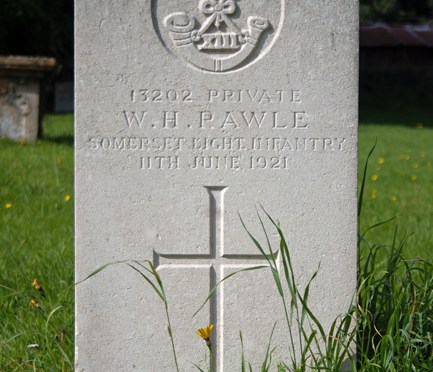
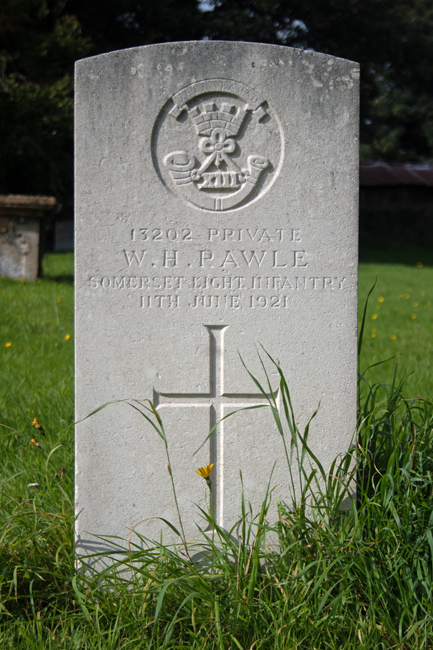
William died on 11th June 1921, aged 27 years old. I have been unable to find anything specific relating to his death and it is likely, therefore, that no misadventure was involved.

Private William Henry Rawle lies at peace in the churchyard of Lydeard St Lawrence, alongside his brothers Stephen and Ernest.


It should be noted that, by June 1921, Louisa Rawle had lost three of their four sons to the Great War. Her husband, George, had also passed away in 1915.

Louisa’s other son – Edward – also served, enlisting in the Somerset Light Infantry and fighting in the Balkans. Private Edward Rawle survived the war, returning home in March 1919.


CWG: Private Ernest Rawle

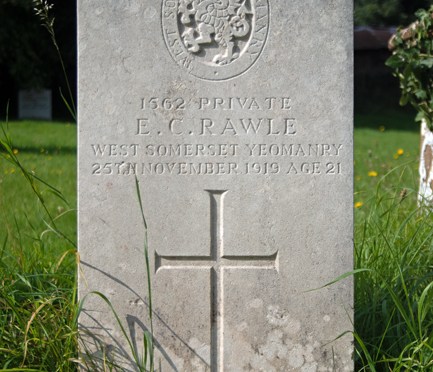
Private Ernest Charles Rawle

Ernest Charles Rawle was born in 1894, the fourth son of George Rawle, a sailor, and Louisa, his wife.

It has not been easy to find information on his war service. What I have been able to ascertain is that Ernest was still at school at the time of the 1911 census, and enlisted in the West Somerset Yeomanry.

He was discharged with a disability on 23rd May 1919, passing just six month later. He was just 21 years old.

Private Ernest Rawle lies at peace in the churchyard of Lydeard St Lawrence, alongside his two brothers, Stephen and William.


CWG: Private Stephen Rawle

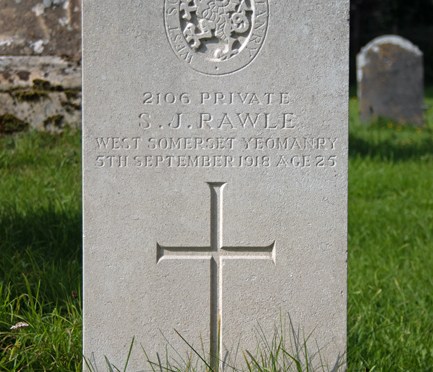
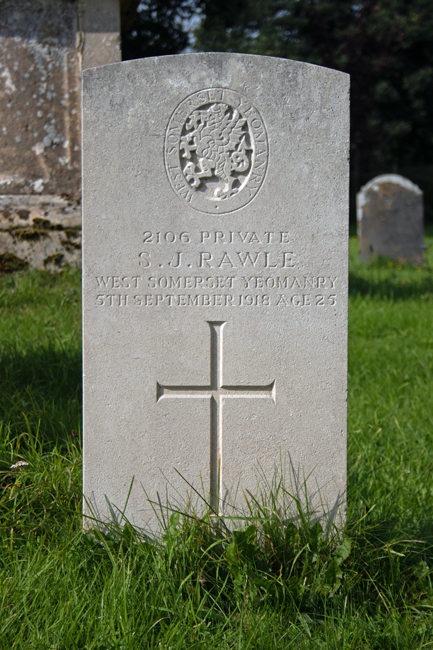
Private Stephen John Rawle

Stephen John Rawle was born in 1894, the second of four sons of George Rawle, a sailor, and Louisa, his wife.

By the time war broke out, Stephen was working as a groom in Wheddon Cross, just south of Minehead.

As the Great War loomed, he enlisted and Private Rawle serving on the home front. His record show that he stood at 5ft 9.5ins (1.76m) and was of good enough health to be enrolled for the Territorial Force. He was assigned to the West Somerset Yeomanry.

He was medically discharged from service on 29th March 1915, having served for one year and 31 days. The records show no signs of injury or wounds, and newspapers of the period do not link him with any misadventure. I can only assume, therefore, that he died of natural causes, possibly linked to the Spanish Flu Pandemic.

Private Stephen John Rawle lies at rest in the churchyard of Lydeard St Lawrence, alongside two of his brothers, Ernest and William.


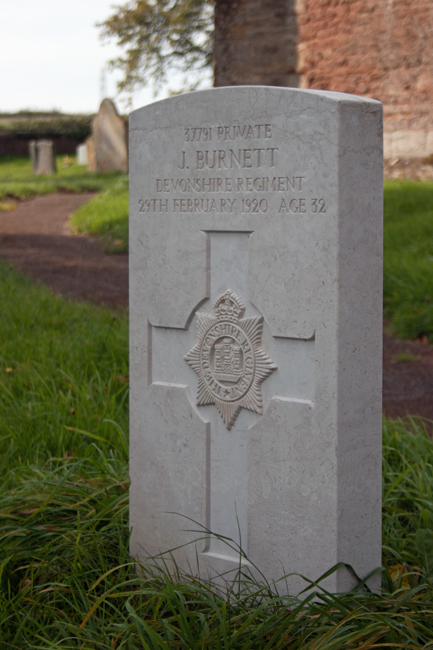
CWG: Private James Burnett

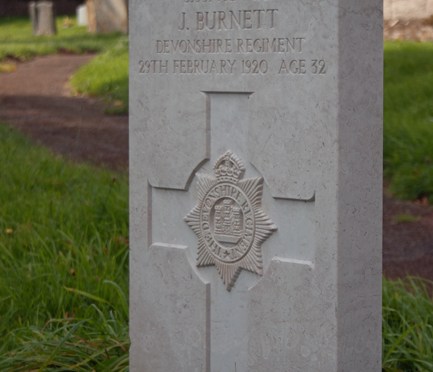
Private James Burnett

James Burnett was born in 1888, the second son of James and Sarah Ann Burnett. James Sr was a farm labourer, and his son quickly followed his line of work.

James enlisted in February 1916. He was noted as being 5ft 2ins (1.58m) tall, and weighed in at 7.5st (47.6kg).

His medical record notes that his sight was such that he should wear glasses constantly, and, in fact, he was signed off medically as Category B1 (“Free from serious organic diseases, able to stand service on Lines of Communication in France, or in garrisons in the tropics. Able to march 5 miles, see to shoot with glasses, and hear well.”)

After training, Private Burnett was mobilised in September 1916, but transferred to the Agricultural Company (of the Labour Corps) in the summer of 1917.

Sadly, however, I have been unable to locate any details of James’ passing. He died on 29th February 1920 and lies at rest in the churchyard of St Lawrence in his home village.